Regenesis Kauaʻi

Environmental Pressures

Food & Resource Security

Economic Context

Waste & Wastewater

Kauaʻi’s only landfill, in Kekaha, is expected to be full around 2030, and a new site is about a decade away. Meanwhile, about 14,000 cesspools release roughly 9.5 million gallons of untreated sewage into the ground every day, and converting them is costly and slow.

Read the full story: Waste & Wastewater

Invasive species ID for growers and home gardens

These five are current official priorities on Kauaʻi: coconut rhinoceros beetle, little fire ant, coqui frog, miconia, and Rapid ʻŌhiʻa Death. KISC is actively responding to all five. The first three are immediate concerns for farms and home gardens; miconia and Rapid ʻŌhiʻa Death also matter for forests, watersheds, and anyone moving plants, soil, or ʻōhiʻa wood. Early reporting makes a large difference. Counts and response plans change; confirm current guidance with the agencies listed before you act.

Photos below are used under public-domain or Creative Commons licenses. Credit, license, and source are listed under each image.

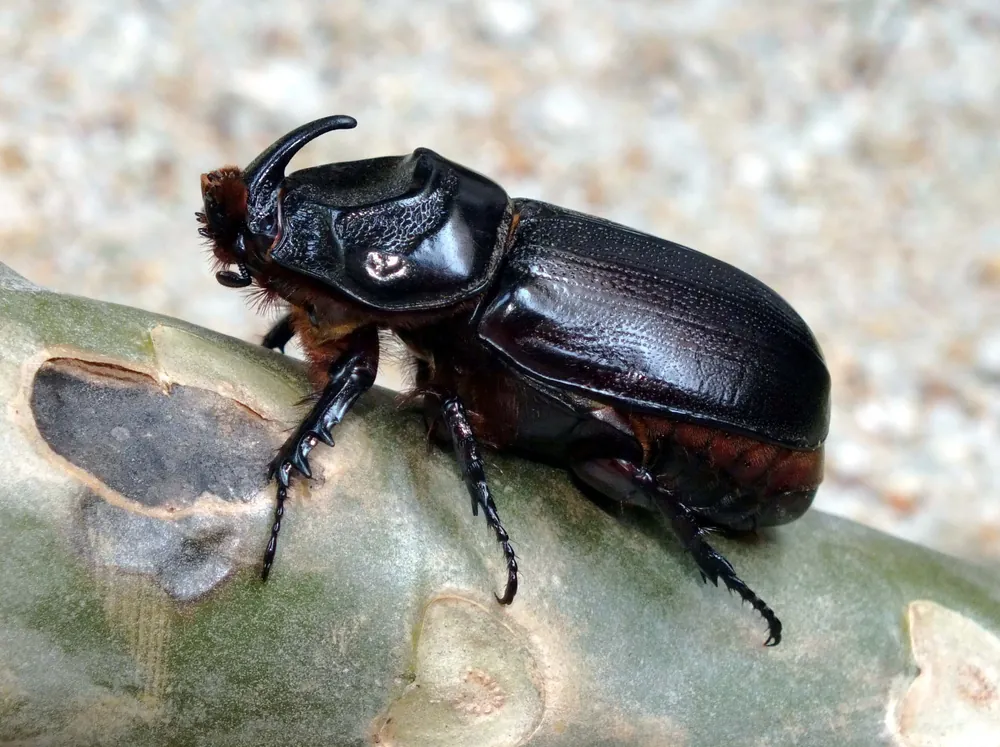
Adult coconut rhinoceros beetle, a glossy black beetle about two inches long with a curved horn on its head, standing on a branch.
Len Worthington, CC BY-SA 2.0, Wikimedia Commons

Coconut rhinoceros beetle

Oryctes rhinoceros

How to spot it

  • Adults are black beetles about 2 inches long. Both males and females have a horn on the head; the male’s horn is usually larger. They are active at night and can fly.
  • Larvae are C-shaped grubs that live in mulch, compost, decomposing stumps, or logs. They feed on decaying plant material for 4–6 months and can reach about 3 inches long. They prefer coconut green waste but can survive in most decaying plant material.
  • Adults bore into the crowns of palms, leaving about 2-inch bore holes. Emerging fronds show distinct V-shaped cuts; on fan palms the damage can appear as scalloped leaf edges.
  • A common look-alike is the oriental flower beetle, which feeds on overripe fruit, nectar, pollen, and sap and is not part of the CRB control program. Do not handle beetles or larvae with bare hands; they may carry diseases.

Why it matters for growers

Adults can feed on and kill coconut, royal, date, and fan palms. If those hosts are scarce, they can shift to other palms and tropical crops. They also threaten Kauaʻi’s endemic loulu fan palms. Grubs spread when people move infested green waste, mulch, soil, or compost. On Kauaʻi, CRB was first detected in May 2023 near the Līhuʻe Airport green-waste transfer station, and KISC reports detections at multiple locations from Hanalei to Kekaha. On islands other than Oʻahu, the CRB Response asks the public to report beetles, larvae, and palm damage.

Who to report it to

  • Statewide pest hotline: 643pest.org or 643-PEST (643-7378). KISC asks that damage or specimens be reported here.
  • Coconut Rhinoceros Beetle Response (for islands other than Oʻahu): crbhawaii.org/report · (808) 679-5244 · [email protected]. Note the location and time; take photos of the beetle, larva, or palm damage; if you collect a specimen, use a sealed hard plastic or glass container and store it in the freezer, covering bare hands.
  • Kauaʻi Invasive Species Committee (KISC): (808) 821-1490 · [email protected]. KISC can also help with monitoring traps and compost-management training.
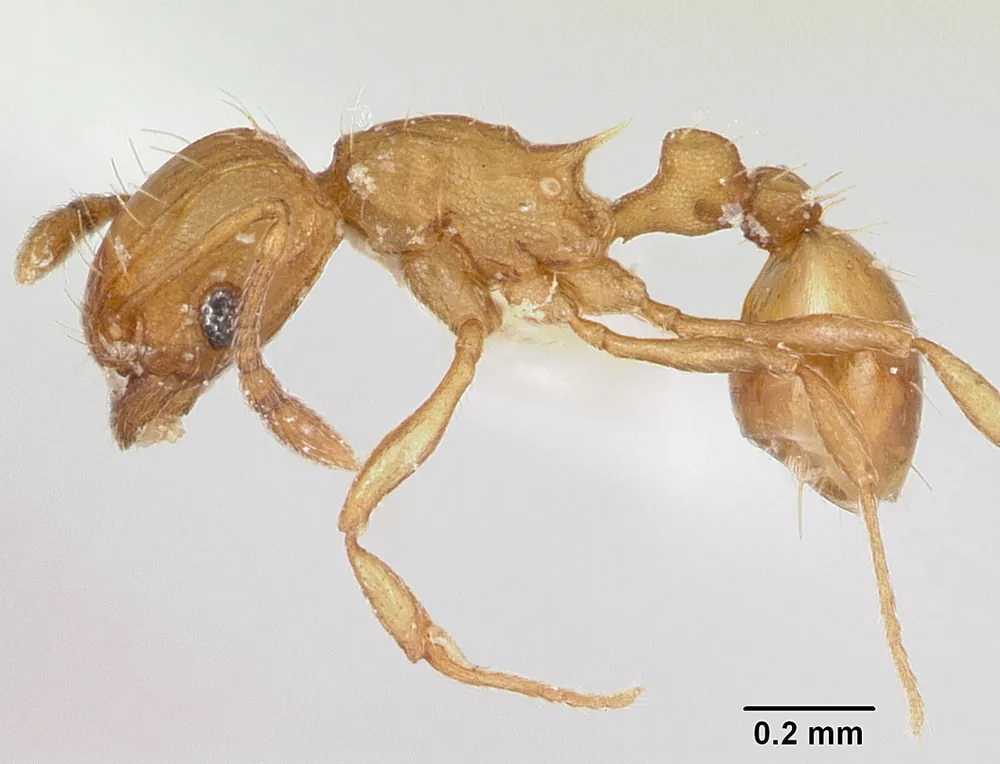
Close-up side view of a little fire ant worker, a tiny orange-brown ant about 1.5 millimeters long, with a 0.2 millimeter scale bar.
April Nobile / AntWeb.org, CC BY 4.0, Wikimedia Commons

Little fire ant

Wasmannia auropunctata

How to spot it

  • Workers are orange-red to light brown and about 1.5 mm long — half the size of a sesame seed, or about as thick as a penny (1/16 inch). They are slow-moving and easily dislodged from leaves, plants, and trees.
  • They do not build mounded dirt nests. They nest on the ground and in trees, and also in potted plants, irrigation lines, and electrical boxes. Infestations are often noticed when ants fall from above and sting the neck, arms, or torso.
  • A common look-alike on Kauaʻi is the tropical fire ant, which is much larger (more than 1/8 inch), builds mounds, moves quickly, and swarms. KISC notes that if you have been stung by an ant on Kauaʻi, it was most likely a tropical fire ant, which is widespread, especially on the south and west sides. Appearance alone is not enough; turn samples in for expert identification.
  • To survey: smear a thin coat of peanut butter on a wooden chopstick or similar stick (or use luncheon meat if you cannot use peanut butter). Place sticks in shady spots in, around, and on plants, including potted plants. Leave them out for about an hour (official instructions range from 45 minutes to at least one hour). Seal the sticks in a plastic bag, label with your name, location, and phone number, freeze for 24 hours, and drop off or mail the bag to KISC or the HDOA office in Līhuʻe. Free test kits are available at Kauaʻi public libraries and at those offices. Farmers and large landowners can ask KISC for larger survey kits.

Why it matters for growers

Little fire ants deliver a painful sting; welts can last for weeks. They infest farms and gardens, sting workers, and protect plant pests such as aphids, whiteflies, and scale. They can move into houses and have been known to cause corneal clouding and blindness in pets. They hitchhike on plants, pots, soil, and other cargo. They are not widely established on Kauaʻi. KISC calls early detection essential and, with HDOA and the Hawaii Ant Lab, treats known sites. New detections are still being found; a current Kauaʻi site map is maintained at stoptheant.org.

Who to report it to

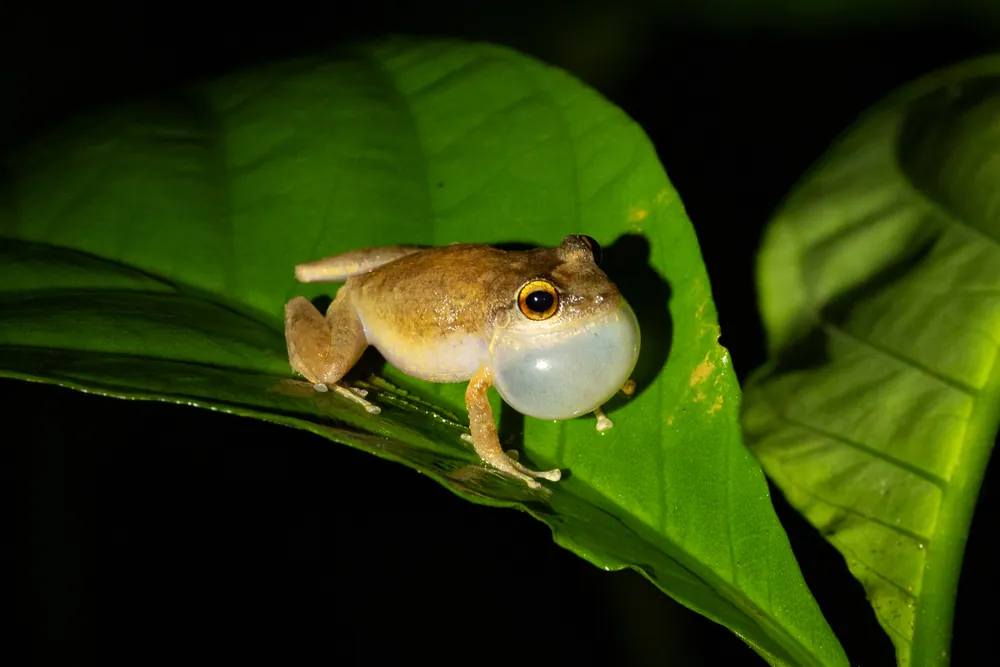
A tan coqui frog sitting on a green leaf at night, with its throat sac inflated as it calls.
Thibaud Aronson, CC BY-SA 4.0, Wikimedia Commons

Coqui frog

Eleutherodactylus coqui

How to spot it

  • A small, night-active frog about the size of a quarter, up to 2 inches long. Color ranges from tan to dark brown, sometimes with a lighter stripe down the back.
  • The male’s mating call is a two-note, high-pitched “co-qui” (pronounced ko-kee). The call can run from dusk until dawn and reach up to 90 decibels.
  • A common look-alike on Kauaʻi is the greenhouse frog, which is widespread, usually slightly smaller than 1 inch, copper-colored with warty skin, and gives a cricket-like call. KISC describes the greenhouse frog as found only on the ground.

Why it matters for growers

Coqui frogs eat large quantities of insects, from the forest floor to the treetops, which can reduce insect services such as pollination. Their presence also hinders plant export. They hitchhike to Kauaʻi on plants and other materials from islands where they are established. After a roughly 10-year, multi-agency effort, a breeding population in Lāwaʻi was declared coqui-free in June 2012. Frogs continue to arrive, and rapid reporting is what prevents them from becoming established again. If you suspect you have heard a coqui on your property, KISC will survey and, if the frog is confirmed, will remove it.

Who to report it to

  • KISC: (808) 821-1490 · [email protected]. Report suspected calling frogs immediately.
  • Hawaiʻi Department of Agriculture: 643-PEST (643-7378) or 643pest.org. You can upload a sound recording with an online report.
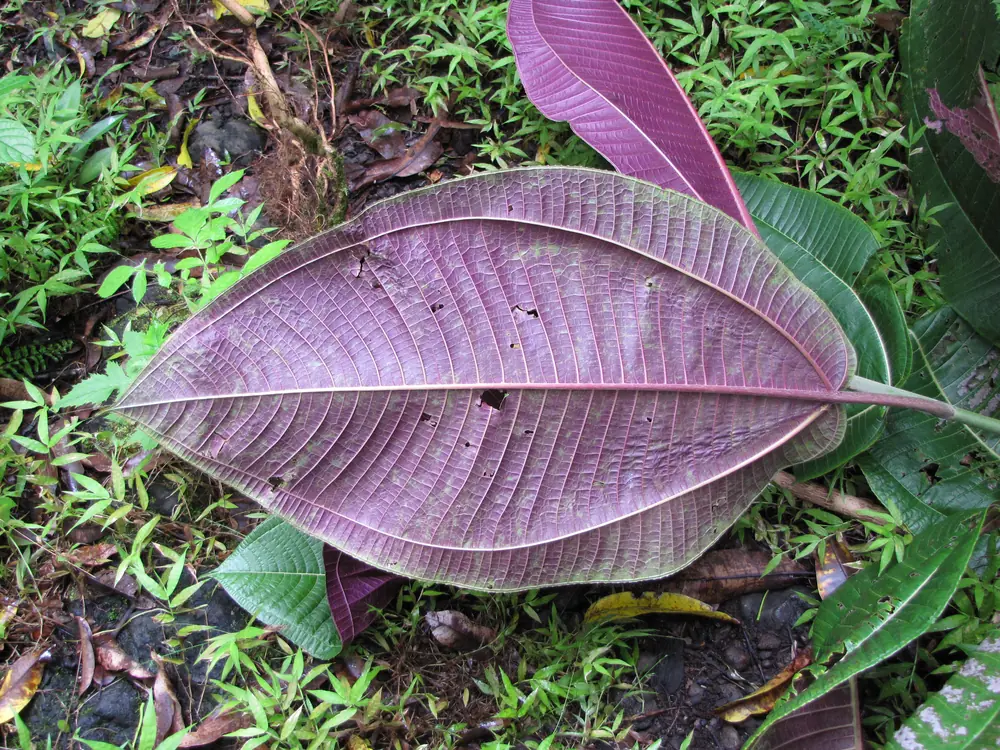
A large oval miconia leaf turned to show its purple underside and three main veins running from the stem to the tip, on a Hawaiian forest floor.
Forest and Kim Starr, CC BY 3.0 US, Wikimedia Commons

Miconia

Miconia calvescens

How to spot it

  • A large tree that can grow up to 50 feet tall, with large, two-foot, oval leaves that are dark green on top and purple underneath. Each leaf has three main midribs running from the stem to the tip.
  • Look-alikes include Koster’s curse (much smaller, solid-colored leaves, a sprawling shrub to about 3 feet), starburst bush (also purple under the leaf, but leaves only grow to about 12 inches and the vein pattern differs), and sanchezia (similar leaf shape but different veins, and a shrub rather than a tree).

Why it matters for growers

Miconia forms thick stands that shade out other plants. Its shallow roots promote erosion. A mature tree can produce about 3 million seeds several times a year, and seeds can remain viable for 16 or more years. Birds spread the tiny seeds, and people spread them in dirt or mud on shoes, clothing, equipment, and vehicles. It is on the Hawaiʻi state noxious weed list. KISC is still actively controlling it on Kauaʻi and, as of a July 2026 update, continues to treat it as a high-priority target. KISC’s miconia page lists known populations in Wailua River State Park, Wailua Homesteads, and the Wailua Game Management Area. If you suspect it on your land, KISC will survey and, if confirmed, remove it, including from landscaping.

Who to report it to

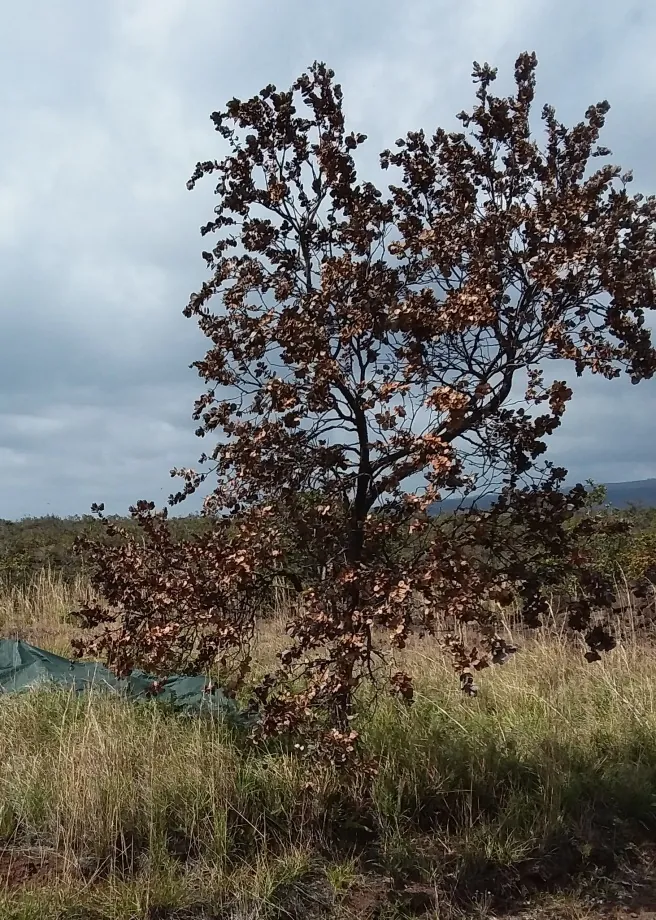
An ʻōhiʻa tree in Hawaiʻi Volcanoes National Park whose entire crown of leaves has turned brown and remains attached to the branches, a typical symptom of Rapid ʻŌhiʻa Death.
Hawaiʻi Volcanoes National Park / U.S. National Park Service, public domain, Wikimedia Commons

Rapid ʻŌhiʻa Death

Caused by Ceratocystis lukuohia and Ceratocystis huliohia, affecting ʻōhiʻa (Metrosideros polymorpha)

How to spot it

  • Leaves on limbs or the entire crown of an ʻōhiʻa tree suddenly turn reddish brown. Dead leaves may stay on the branches for some time. The fungi themselves cannot be seen from the outside; a tree may be infected for months before symptoms appear.
  • With C. lukuohia (a wilt disease, the more aggressive of the two), the entire canopy tends to turn reddish brown all at once. With C. huliohia (a canker disease), leaves often brown a limb or two at a time.
  • Confirmation requires a wood sample taken by trained technicians and tested in a laboratory. Do not cut or sample a suspect tree yourself. If you see an ʻōhiʻa with a limb or crown turning brown, take a photograph and report the exact location.

Why it matters for growers

ʻŌhiʻa is the keystone tree of Hawaiʻi’s native forests and an important part of the watershed that supplies water for agriculture and communities. There is currently no known cure, so preventing spread is the main action. The disease enters through wounds — from pruning, heavy equipment, animals, or storm damage. People can spread it by moving infected ʻōhiʻa plants, plant parts, wood, or soil. Both fungi have been confirmed on Kauaʻi since the disease was first found here in 2018, in Moloaʻa State Forest Reserve. Avoid injuring ʻōhiʻa; do not move ʻōhiʻa wood, parts, or adjacent soil, and do not take ʻōhiʻa material to green-waste stations; clean soil off tools, shoes, and vehicles, then spray tools and gear with 70% rubbing alcohol.

Who to report it to

  • Kauaʻi Rapid ʻŌhiʻa Death Rapid Response Team / KISC: email photographs of the suspect tree, its exact location, and your contact information to [email protected], or call KISC at (808) 821-1490.
  • Background and prevention steps: UH CTAHR’s Rapid ʻŌhiʻa Death site, rod.ctahr.hawaii.edu.

Other invasive plants relevant to food forests

General practice: Prefer locally adapted or carefully sourced plants. Inspect everything that arrives with soil or mulch. When in doubt, contact KISC before moving material or planting something unfamiliar.

Key reporting and information contacts

Sources

Facts, phone numbers, and links on this page were checked against the official pages below on November 14, 2026 (Hawaiʻi–Aleutian time). Situation changes quickly. Always verify current status and recommended actions with KISC, 643-PEST, or, for Rapid ʻŌhiʻa Death, [email protected], before relying on these notes.

The way forward

These challenges are serious, but they also create clear opportunities. Systems that build soil, catch and store water, produce staple foods, and increase local self-reliance directly address the island’s most pressing needs. The rest of this site shows how to start, one bed at a time.

Free guide: The 7-Layer Island Backyard

A 20-page guide to a Hawaiʻi garden that looks like a forest, free by email.