Practical frameworks for agroforestry and food forests, zones, guilds, water, and soil systems that work with Kauaʻi’s conditions. New to the idea? Start with What Is Agroforestry?
Disclaimer: These guides are practical starting information, not professional design, engineering, or legal advice. Site conditions, permitting, and local rules vary. Confirm requirements with the Hawaiʻi Department of Health, Kauaʻi County (Planning, Public Works, and other relevant offices), and qualified local professionals before implementing systems that involve grading, water, wastewater, or structures.
Agroforestry means growing trees and shrubs together with food crops (and sometimes animals) on the same land, arranged so each part supports the others. The trees give shade, wind shelter, mulch, and fertility; the crops and ground covers protect the soil and give harvests while the trees grow. Regenerative agroforestry goes one step further: it aims to leave the soil, water, and land healthier every year, while needing fewer outside inputs like fertilizer, bought mulch, and irrigation.
A food forest is one kind of agroforestry, and it’s the main focus of this site. But the same ideas work at every scale, from a backyard bed to a small farm.
| Conventional annual garden | Regenerative agroforestry | |
|---|---|---|
| Plants | Annual crops in rows, replanted every season | Perennial trees, shrubs, and ground covers in layers, plus some annuals |
| Soil | Tilled; often bare between crops | Never dug; always covered with mulch or living plants |
| Fertility | Bought fertilizer and compost | Grown on site: nitrogen fixers and chop-and-drop mulch |
| Water | Regular irrigation | Mulch, shade, and earthworks hold rain in the soil |
| Pests | Sprays when problems appear | Diversity and habitat for helpful insects prevent most outbreaks |
| Harvest | A few crops, in seasons | Many crops, spread through the year |
| Over time | Same work and inputs every year | Less work and fewer inputs as the system matures |
Several layers of food plants, from canopy trees down to ground covers, planted close together like a young forest. Best for home gardens and small plots. See Tropical Food Forest Basics below.
Rows of trees or nitrogen fixers (pigeon pea, gliricidia) with crops grown in the alleys between. The rows are pruned regularly and the trimmings mulch the alleys. Suits larger, flatter ground.
Hedges and lines of trees that cut the trade winds, shelter crops, and give mulch, fodder, or fruit. Gliricidia cuttings can root to become living fence posts.
Trees combined with grazing animals or poultry. Animals clean up fallen fruit and add manure; trees give them shade and feed. See Animals.
Strips of trees, shrubs, and grasses along streams and gulches that catch runoff and soil before they reach the water. See Water Management.
Dense rows of plants like vetiver or pigeon pea planted across a slope to trap soil and slow runoff. The safest way to farm steeper ground.
Our free guide, The 7-Layer Island Backyard, covers the seven layers, zones, soil tests and three starter guilds you can plant this month.
A food forest mimics a young woodland while producing food, materials, and ecological benefits. Success depends on matching plants to your specific rainfall, elevation, wind, and soil.
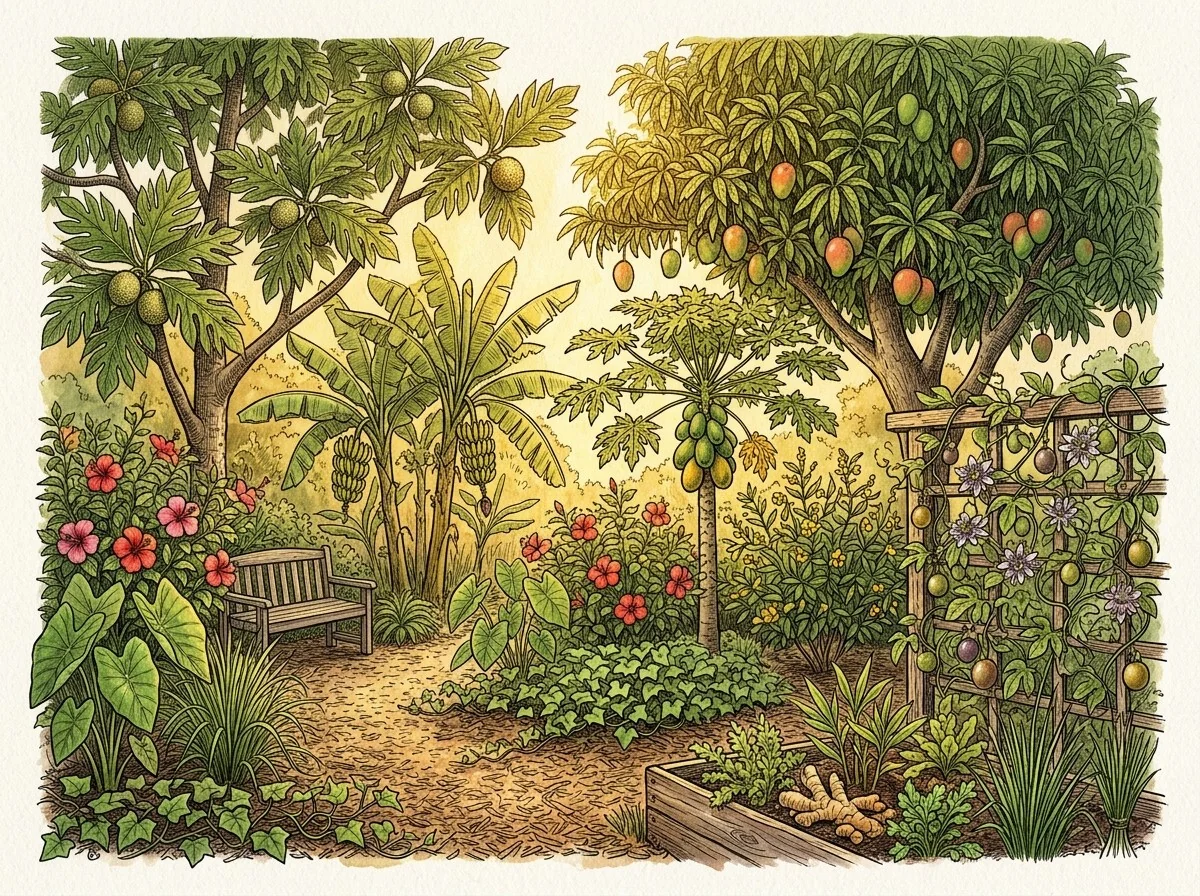
Zones place elements according to how often you use or maintain them.
Place daily-harvest plants closest to the house. Even on small lots the zone concept improves efficiency.
Mountain apple or breadfruit + banana + pigeon pea + ginger/turmeric/katuk + Okinawa spinach/sweet potato.
Mango or moringa + banana + pigeon pea/gliricidia + chaya/lemongrass + sweet potato/sissoo.
Coconut or breadfruit + additional breadfruit/avocado + banana + nitrogen-fixers + upland taro/cassava + perennial greens.
Wetter areas: emphasize drainage. Drier areas: heavy mulch and drought-tolerant species are essential.
Expand only after the first section is stable. Secure water and maintain diversity.
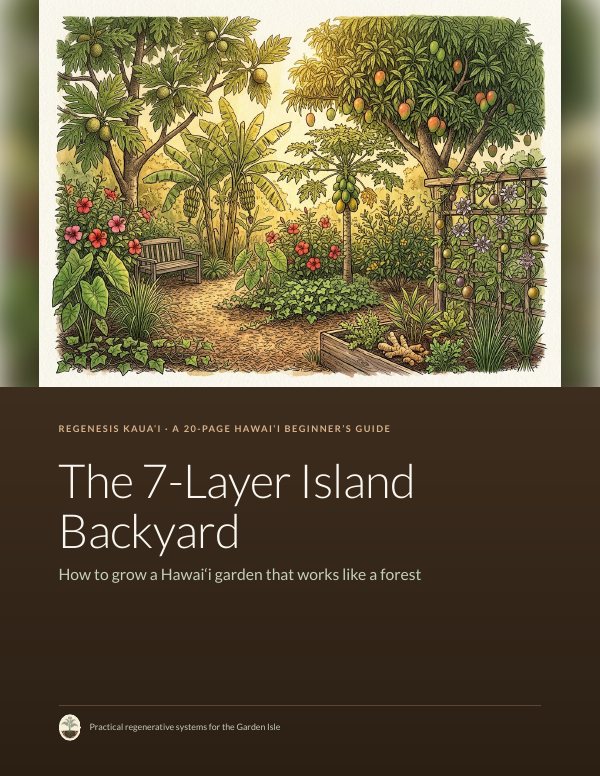
A 20-page guide to a Hawaiʻi garden that looks like a forest, free by email.